
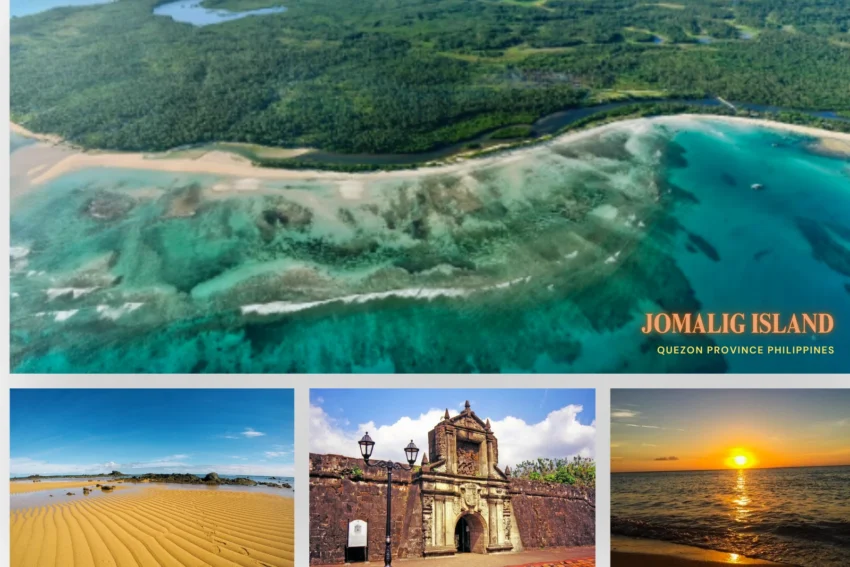
Jomalig Island is the kind of place that makes you work a little before revealing why people travel so far to see it.
You do not simply step off a bus and find yourself beside a beautiful beach. Reaching this remote municipality in Quezon means travelling to Real, getting to the port early, and spending several hours crossing open water toward the Pacific.
Then the coastline begins to appear.
What waits there is surprisingly varied. Golden beaches stretch beside clear blue water. Sand ripples form near rugged rock formations. Coconut-lined shores look almost untouched, while grassy viewpoints rise over coves exposed to the Pacific Ocean.
Jomalig is officially part of the Polillo group of islands in Quezon Province. The Quezon Provincial Government lists Salibungot Golden Sand, Lingayen Cove, Kanaway Beach, Turtle Rock and Manlanat Island among its main attractions.
And in 2026, the island is no longer quite as unknown as it once was.
Tourism is growing, roads and local infrastructure are improving, and the provincial government held a tourism stakeholders’ meeting in Jomalig in May 2026 to discuss services, cleanliness, tourism development and the challenges facing resorts and local operators.
Still, getting there remains part of the adventure.
Where Is Jomalig Island?
Jomalig lies far off the eastern coast of mainland Quezon, facing the Pacific Ocean.
It is one of the municipalities in the Polillo group of islands, but unlike destinations that can be reached through a short ferry ride, Jomalig requires patience.
The provincial government lists its land area at about 5,170 hectares. It is divided into five barangays: Apad, Bukal, Casuguran, Gango and Talisoy.
Its distance from mainland Luzon also explains part of its character.
Once you move away from the town centre, the scenery feels open. Coconut trees line long stretches of road. Grasslands appear beside the sea. Small communities are separated by beaches, farms and long views toward the horizon.
You are constantly reminded that this is an island in the Pacific, not simply another beach town a few hours outside Manila.
How Do You Get to Jomalig Island From Real, Quezon?
Most DIY travellers reach Jomalig through Ungos Port in Real, Quezon.
The important thing is to arrive early.
Passenger and cargo boats normally leave in the morning, but schedules are not something I would build a trip around too rigidly. Boats can leave earlier, later or not at all depending on the operator, passenger load and sea conditions.
Recent 2026 travel information places the crossing at roughly four to six hours. Published fares currently vary between about ₱400 and ₱500 one way, which is a good reminder to confirm the fare and departure time directly before travelling.
If you want the earliest available trip, reaching Real the night before is the safer approach.
This also gives you time to eat breakfast, buy water and snacks, and get to the port without rushing.
The first part of the sea journey can feel peaceful.
From the boat, you may see other islands in the Polillo group while mainland Luzon slowly disappears behind you. Farther into the crossing, however, the water can become noticeably rougher because Jomalig faces the open Pacific.
Anyone prone to seasickness should prepare for that before boarding.
The long crossing is also one reason Jomalig still feels different from many easier-to-reach beach destinations.
What Does Arriving in Jomalig Feel Like?
The first view of Jomalig can be deceptive.
From offshore, you mainly see a low green island surrounded by blue water.
Once you come closer, details begin to separate themselves from the landscape. Small boats move near the shore. Coconut trees rise behind the coast. Houses and simple structures appear around the landing areas.
The water close to shore can also be remarkably clear.
Because parts of the approach are shallow, landing arrangements may depend on the boat and tide. Some travellers are transferred closer to shore using smaller craft or local balsas.
After registration, motorcycles become one of the most practical ways to continue toward accommodations and attractions.
And this is when Jomalig becomes much more interesting.
The island is larger than it first appears, and trying to see everything in one hurried day would miss much of what makes the trip worthwhile.
What Is Salibungot Beach Like?
Salibungot is one of the places most closely associated with Jomalig.
Instead of the bright powdery white sand people often expect from Philippine islands, sections of the beach have a warm golden tone.
The shoreline is broad enough in places that walking beside the water feels almost like crossing a long open field of sand.
Near sunset, the colours become softer.
The water reflects the changing sky while visitors slowly gather along the coast to watch the sun disappear. There is no need for a complicated activity here. Walking, swimming and simply staying until late afternoon are enough.
That simplicity is part of Salibungot’s appeal.
It gives you space to stop moving before the next day’s much longer island tour.
What Makes Kanaway Beach and Turtle Rock Different?
Kanaway shows another side of Jomalig.
Here, the landscape becomes rougher.
Instead of one uninterrupted beach, you find tidal flats, exposed rocks and wide patches of sand that change shape depending on the movement of the water.
At low tide, ripples can appear across the sand like tiny dunes.
Kanaway sits on the eastern side of the island near the Pacific, and older geographic documentation describes an expansive golden-sand area beside nearby islets and tidal formations.
Then there are the rocks.
Turtle Rock is one of the most photographed formations around this part of Jomalig. From certain angles, the shape resembles a turtle resting beside the sea.
Nearby rock formations give the coastline a more dramatic appearance.
This is not the gentle tropical-beach scenery you see everywhere. The exposed Pacific side feels rawer, which makes Kanaway especially interesting when the tide exposes the sand formations around it.
Is Little Boracay Worth Visiting?
The nickname immediately creates expectations.
Jomalig’s so-called Little Boracay is not a miniature copy of Boracay, and it is better appreciated without making that comparison too literally.
What you get instead is a calm tropical beach with fine light-coloured sand, clear water and coconut trees leaning toward the shoreline.
Hammocks are sometimes tied beneath the trees.
There are spots where you can sit in the shade and look straight out toward the water, which gives the beach a more relaxed feel compared with some of Jomalig’s rockier attractions.
This is the kind of place where rushing makes little sense.
After hours of riding around the island, sitting under a coconut tree can become one of the more memorable parts of the day.
Why Is Lingayen Cove Called Little Batanes?
Lingayen Cove changes the scenery once again.
The attraction is widely known as Little Batanes because of its elevated grassy landscape, rocky coastline and broad views over the sea.
You climb above the beach rather than simply staying beside it.
From higher ground, the coastline stretches across your field of view. Pale sand runs beneath the cliffs while the Pacific fills almost everything beyond it.
Large rock formations sit near the cove.
Stand in one direction and you see the beach. Turn around and the view becomes rock, grass and open ocean.
The comparison with Batanes comes from the scenery rather than from an exact resemblance.
What matters is how unexpectedly different it looks from the beaches you may have visited only an hour earlier.
What Is Begwangan Marsh?
Beaches may dominate most Jomalig itineraries, but the marshlands offer one of the island’s most interesting changes of pace.
Around Begwangan, water moves quietly between mangroves and wetland vegetation.
Instead of waves and exposed coast, you find still waters, roots and trees reflected on the surface.
It also reveals something travellers may overlook when visiting an island surrounded by saltwater.
Wetlands act as natural catchment areas, creating freshwater environments that support plants, fish and birdlife.
In 2026, provincial infrastructure work was also completed around Sitio Bigwangan in Barangay Talisoy, where a bridge improvement project was inaugurated in May to make travel easier for residents, students, fishermen and visitors.
Protecting these areas matters just as much as maintaining the beaches.
A place like Jomalig stays beautiful only when the quiet corners are treated with the same care as its famous viewpoints.
What Is the Best Way to Get Around Jomalig Island?
For most DIY travellers, the motorcycle or habal-habal remains the most practical way to explore Jomalig.
Distances between attractions are longer than they look on a map.
Some roads are paved and surprisingly smooth, while other stretches pass through sand, grasslands, coconut plantations or rougher tracks.
Current 2026 travel guides commonly quote around ₱600 per passenger for a full-day habal-habal circuit, although actual prices can vary depending on your itinerary and arrangements.
Discuss the route before leaving.
A typical full-day circuit can combine Kanaway, Turtle Rock, Little Boracay and Lingayen Cove, while other stops depend on the weather, tide and how much time you have.
The motorcycle rides between the attractions are not wasted time.
Some of the best scenes on Jomalig appear along the road itself.
How Many Days Should You Spend in Jomalig?
I would not recommend treating Jomalig as an overnight side trip.
You spend too much time reaching the island.
A three-day, two-night stay is a much more sensible minimum for DIY travellers.
Your first day can be used for the crossing, checking in and watching the sunset at Salibungot.
The second day can be devoted to the main land attractions.
If conditions allow, a third morning gives you time for island hopping, another beach, the marshlands or simply a slower start before returning to Real.
Four days would be even better for travellers who dislike rushing.
The farther you travel to reach a place, the less sense it makes to leave before you have actually had time to experience it.
How Much Should You Budget for Jomalig Island in 2026?
Jomalig can still be travelled on a relatively modest budget, but prices should be treated as estimates.
A September 2026 travel report places the basic Real-to-Jomalig boat fare at about ₱400 one way and a three-day trip at around ₱4,000 per person, depending on accommodation, meals and activities.
Another updated guide lists passenger boats at around ₱500 each way.
That difference is exactly why I would bring extra cash.
Do not assume ATMs, card terminals or mobile-wallet payments will always be convenient once you are moving between remote beaches.
Recent travel information also reports a consolidated environmental and tourism charge of around ₱170, with some individual attractions collecting separate entrance fees.
Treat those amounts as planning figures rather than guaranteed prices.
Rates, boat schedules and local fees are among the first things I would reconfirm with your accommodation or the tourism office shortly before departure.
When Is the Best Time to Visit Jomalig Island?
Weather matters more here than at many destinations.
The island faces the Pacific Ocean, and that long boat crossing becomes a completely different experience when winds and waves strengthen.
Recent travel guidance recommends the generally calmer November to May period, while the wetter months from June through October can bring rougher seas and more unpredictable crossings.
Even during the dry season, conditions can change.
Check the weather forecast before travelling and take boat cancellations seriously.
The sea is not merely the road to Jomalig.
It decides whether that road is open at all.
Practical Jomalig Island Tips for DIY Travelers
Leave some flexibility in your schedule.
A trip to Jomalig should never be planned so tightly that one cancelled boat causes you to miss a flight, workday or major appointment.
Bring cash, drinking water, sun protection, motion-sickness medicine, a dry bag and a power bank.
Book accommodation before arriving, especially on weekends and during the summer travel season.
Also ask your resort to help verify the next available boat from Real.
Mobile connectivity has improved, but signal quality can still depend on where you are around the island. Do not plan on working remotely from an isolated beach as though you were sitting in a city café.
Most importantly, remember that these are communities, not just photo locations.
Jomalig’s tourism sector is actively developing, and provincial officials said in May 2026 that preserving cleanliness and the island’s natural beauty remains part of that effort.
Visitors have a role in keeping it that way.
Frequently Asked Questions About Jomalig Island
1. Where is Jomalig Island located?
Jomalig is an island municipality in Quezon Province and part of the Polillo group of islands east of mainland Luzon. It faces the Pacific Ocean.
2. How long is the boat ride from Real to Jomalig?
Allow roughly four to six hours depending on the boat and sea conditions. Rough Pacific waters can make the journey longer.
3. How much is the boat fare to Jomalig in 2026?
Recent sources report roughly ₱400 to ₱500 one way.
Because fares and departures can change by operator and weather, confirm the amount directly before your trip.
4. What are the best places to visit in Jomalig?
The major attractions include Salibungot Golden Sand, Kanaway Beach, Turtle Rock, Lingayen Cove and Manlanat Island.
5. How many days do you need in Jomalig?
Three days and two nights is a practical minimum.
It gives you one arrival day, one full touring day and enough time to return without turning the entire trip into a race.
6. Is Jomalig good for DIY travellers?
Yes, but it requires more planning than destinations with frequent ferry connections.
Arrange your accommodation, ask about boats before travelling and coordinate a habal-habal tour once you arrive.
7. Is there electricity and mobile signals on Jomalig?
Electricity and telecommunications have improved compared with earlier years, particularly around populated areas.
Conditions at remote beaches may still differ, so a charged power bank and offline copies of important travel information are useful.
8. What is the best month to visit Jomalig?
The November-to-May period generally offers better conditions for the long sea crossing.
Always check the actual forecast because Pacific conditions can change even during normally favourable months.
9. Is Jomalig Island expensive?
Not necessarily.
A budget of roughly ₱4,000 or more per person for three days is a useful starting point, but private rooms, island hopping, food choices and transportation can raise the total considerably.
10. Is travelling all the way to Jomalig worth it?
That depends on what you expect from a trip.
If you want malls, nightlife and effortless transportation, there are easier destinations.
But if the idea of spending hours crossing the sea before riding a motorcycle past coconut trees, golden beaches, marshlands, grassy cliffs and quiet coastal communities sounds appealing, the difficult journey becomes part of the reason to go.
Jomalig does not reward travellers by making everything easy.
It rewards those willing to travel slowly enough to notice how many different landscapes can exist on one small island.
Sometimes the places that stay with us longest are not the ones we reached fastest, but the ones that made us look out the window, hold on through the rough parts, and wonder what might be waiting beyond the next stretch of sea.