
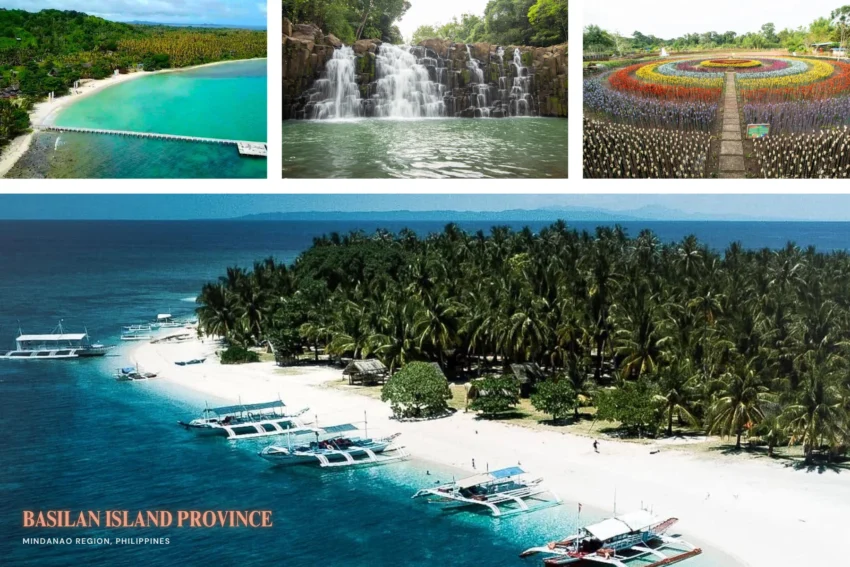
Basilan is one of those places that can surprise you before you even reach the destination.
The beaches are part of the story, but so are the roads between them. A trip across the island can take you past rubber plantations, old wooden bridges, small villages, mountain roads, fruit trees, quiet coastlines and places that carry a much deeper history than their scenery first suggests.
Then there is Tenusa Island.
The water changes from deep blue to a clearer turquoise as the boat gets closer. Onshore, the sand looks almost powdery, with coconut trees behind it and very little of the commercial development you would normally expect around a white-sand beach.
And farther west, hidden below a steep trail in Upper Garlayan, Maluso, another surprise waits among the trees.
The Department of Tourism now lists Basilan among its BARMM destinations and specifically highlights Tenusa Island, Malamawi Beach and Bulingan Falls as places worth seeing. DOT describes Tenusa as an uncrowded island with powdery white sand and clear turquoise water, reached by a short boat ride from Sumisip.
One important naming note before planning a trip: the island is sometimes referred to as Tinusi or Tinuse in videos and older online posts, but the Department of Tourism currently uses Tenusa Island.
What Makes the Isabela City to Sumisip Road Trip Interesting?
This is not the kind of road trip where you spend the entire journey waiting for the next tourist attraction.
Leaving Isabela City and heading toward Sumisip, the landscape itself becomes part of the experience. Rubber trees begin appearing along the road, sometimes close enough together that their branches create a green corridor above passing motorcycles and vehicles.
Basilan has long been associated with rubber production, and on this route you actually see where that reputation comes from.
There are sections where the road narrows, old bridges appear and pavement gives way to gravel or rougher ground. In the trip documented here, portions of the route were still unfinished, with loose rocks, uneven surfaces and sections that would become much more difficult after heavy rain.
Then the road suddenly improves again.
Newer concrete sections, roadside poles and other infrastructure are signs of how access between communities continues to change. That matters to travelers, but it matters even more to the people who use these roads every day to reach schools, markets, municipal centers and neighboring barangays.
And one of the most meaningful stops appears before the scenery has a chance to make you forget the area’s history.
Why Visit the Kasanyangan Peace Monument in Sumisip?
The Kasanyangan Peace Monument stands at the rotunda in Barangay Mahatallang, Sumisip.
It is not simply another roadside monument.
The Philippine Information Agency says the monument was unveiled in March 2023 in an area that had previously experienced serious armed conflict. Decommissioned firearms were incorporated into the site as a symbol of Basilan’s efforts toward peace and reconciliation.
That gives the stop more weight when you arrive by road.
You can look at the surrounding mountains, villages and passing motorcycles and realize that this ordinary movement of people is itself part of the story. In March 2024, President Ferdinand Marcos Jr. also visited the monument for a peace ceremony, describing the area as one that had undergone a significant transformation from its conflict-affected past.
The monument does not erase what happened here.
It gives visitors a physical place where Basilan’s difficult history and its present-day efforts to move forward meet, which makes the next stretch of the journey feel different.
What Is Tenusa Island in Sumisip Like?
Tenusa Island is the point where this road trip suddenly becomes an island escape.
From the municipal side of Sumisip, travelers can continue toward the coastal area around Barangay Bul-Buli and take a small local boat across the water.
The Department of Tourism describes Tenusa as only around five minutes by boat from Sumisip and highlights its fine white sand, coconut trees and turquoise water.
The approach may be the best part.
At first, you see a strip of pale sand ahead. Then the water becomes progressively clearer, especially in the shallows near shore.
Once you step onto the beach, the sand is noticeably fine.
There is little here to distract from the landscape. Coconut trees rise behind the beach, while a simple pier or jambatan extends over the water.
It feels very different from established Philippine beach destinations filled with restaurants, souvenir shops and rows of resorts.
That lack of development is also the reason travelers should arrive prepared.
Do not assume there will be stores, restaurants, ATMs or complete tourist facilities waiting on the island. Bringing drinking water, sun protection and basic food is sensible, and arranging the boat and visiting with people in the community before arriving is even better.
An older traveler review also recommended coordinating with the local tourism office before visiting Tenusa.
And whatever you carry onto the island should leave with you.
What Yakan Food Should You Try in Basilan?
The scenery may bring you to Basilan, but food can explain parts of the culture that landscapes cannot.
One dish worth looking for is kàliya, a traditional Yakan preparation using native chicken.
The Komisyon sa Wikang Filipino’s documentation of Yakan culture describes kàliya as native chicken cooked with coconut milk and cassava used to thicken the sauce. Ingredients can also include chilli, ginger, spring onion, garlic and lemongrass.
That explains its unusual texture.
At the beginning of cooking, it can look like chicken simmering in coconut milk. As the thickening ingredients are worked into the dish, however, the liquid becomes heavier and begins clinging to the chicken.
The result is rich, spicy and filling.
In the trip documented here, the chicken was paired with a cassava-based accompaniment called puto. Other sources on southern Philippine cuisine also record cassava-based staples under names such as piutu, piyutu or putu, although preparation can vary between communities.
Food like this is worth trying slowly.
You are not simply ordering something because it is famous. You are tasting a dish whose preparation, ingredients and place at the table are connected to Yakan household and ceremonial traditions.
What Fruits Can You Find in Basilan?
If you happen to arrive during a productive fruit season, the roadside can become another attraction.
Rambutan trees can become heavy with red fruit.
Lanzones may grow in clusters directly from the trunk and larger branches, something people who normally see the fruit only piled inside market baskets rarely get to observe.
Then there is marang.
Its appearance can be unfamiliar the first time you encounter it hanging from a tree. Once opened, the inside reveals soft, pale segments with a strong tropical aroma.
Durian and other tropical fruits may also appear depending on the season and location.
The most enjoyable part is not necessarily finding some rare fruit.
It is seeing food where it actually grows.
Picking lanzones from a branch or opening a freshly harvested marang makes an ordinary snack feel completely different from buying the same fruit several days later in a city market.
And after all that food, the road continues toward Maluso.
How Do You Reach Garlayan Falls in Maluso?
From Sumisip, the journey continues toward the municipality of Maluso and Barangay Upper Garlayan.
Upper Garlayan is an officially recognized barangay of Maluso. Philippine Statistics Authority records list it among the municipality’s 20 barangays.
From the community near the local elementary school, the trip described here continues on foot.
The trail immediately begins descending.
Parts can be steep and slippery, and a rope has been installed along sections of the path to give visitors something to hold.
It is not a long trek.
In the documented visit, walking from the parking area to the falls took roughly five minutes, although the climb back up is naturally more tiring.
Then the sound of rushing water becomes louder.
Rocks begin appearing beside the trail, vegetation opens and the waterfall finally comes into view.
What Does Garlayan Falls Look Like?
Garlayan Falls feels bigger when seen from below.
Water drops over a high rock wall and spreads across sections of the cliff before crashing into the natural pool underneath.
The surrounding greenery makes the falling water look even brighter.
Unlike a landscaped resort waterfall, there are still rocks around the pool and natural sections where visitors have to watch every step.
The footage also shows shallow areas near the sides and deeper water closer to the main cascade.
A local guide in the documented visit placed the height at about 25 metres and described deeper portions of the pool as reaching around 10 feet. I could verify Upper Garlayan as the barangay through PSA records, but I could not find a sufficiently authoritative published source confirming those exact waterfall measurements, so they are best treated as local estimates rather than official figures.
That distinction matters when planning a swim.
Water depth and current can also change after rain, so even familiar swimming areas should not be treated as permanently predictable.
The beauty of this place comes partly from how natural it still feels.
And that also means travelers need to be more responsible for themselves.
What Should DIY Travelers Bring to Garlayan Falls?
Wear footwear with enough grip for the downhill trail.
Slippers may be comfortable around the pool, but they are not ideal on wet soil, loose leaves or steep sections of trail.
Bring drinking water as well.
The local account in the footage says visitors may bring their own food and that there was no entrance fee during that particular visit.
However, community rules and fees can change.
DIY travelers should confirm current arrangements with the barangay or Maluso tourism authorities rather than assuming a previous visitor’s experience still applies.
Take particular care with children around the pool.
Shallow water near the edge does not mean the entire swimming area is shallow.
And perhaps the easiest rule to remember is this: anything you carry down the trail should come back up with you.
Is Basilan Safe for Tourists in 2026?
This is one part of the article where a simple answer would not be responsible.
Local officials and residents have repeatedly described major improvements in peace and mobility, and national government sources have documented Basilan’s peace-building efforts around Sumisip and the Kasanyangan Monument. The national Department of Tourism is also actively featuring Basilan attractions on its tourism website.
However, travelers should not interpret that as meaning there are no security considerations.
As of September 26, 2026, the UK Foreign, Commonwealth & Development Office continues to advise against travel to the Sulu archipelago, while the United State Department lists the Sulu Archipelago under its “Do Not Travel” areas because of terrorism, unrest, crime and kidnapping concerns.
Travel conditions can also differ greatly from one municipality or barangay to another.
For DIY travel in Basilan, it makes sense to contact local tourism officials before the trip, inform people locally about the intended route, avoid improvising unfamiliar remote detours and check current local conditions shortly before departure.
This is particularly important for destinations away from established town centers.
Good travel writing should show how a place has changed without pretending that every concern disappeared with that change.
How Do You Get to Basilan?
For most travelers coming from outside the province, Zamboanga City is the practical gateway.
MARINA’s March 2026 Philippine Nautical Highway Matrix lists daytime passenger services connecting Zamboanga with Isabela City in Basilan. Ferry operators, vessels and departure times can change, so check the latest schedule before going to the port.
Once in Isabela City, local transportation can take you farther into Basilan.
For a route involving Sumisip, Tenusa Island and Upper Garlayan, arranging a motorcycle, vehicle or local driver in advance will make the trip much easier than trying to assemble transport one segment at a time.
Road conditions are another reason not to rely completely on map estimates.
A distance that looks short on a phone can take considerably longer when the road includes construction, gravel, muddy sections or unfamiliar intersections.
Start early.
Basilan is much more enjoyable when you are looking at the landscape instead of racing daylight.
What Other Places Can You Visit in Basilan?
If you have additional time, Malamawi Beach near Isabela City is one of Basilan’s better-known coastal destinations.
The Department of Tourism describes it as a white-sand beach with turquoise water, shallow coral areas and a relatively quiet atmosphere compared with heavily developed beach destinations.
Another option is Bulingan Falls in Lamitan.
Its appearance is completely different from Garlayan Falls because water flows over unusual column-like rock formations surrounded by greenery. DOT also lists it among Basilan’s featured attractions.
Adding either destination gives the trip a useful contrast.
Tenusa is about open sea and white sand.
Garlayan is about forest, rock and falling water.
Bulingan offers another type of waterfall landscape, while Malamawi gives travelers an easier beach option closer to Isabela City.
But some of the strongest memories may still come from the spaces between them.
A wooden bridge.
Rows of rubber trees.
A winding road descending toward the sea.
A fruit tree heavy with rambutan.
Sometimes those ordinary scenes tell you more about a province than another famous viewpoint ever could.
Frequently Asked Questions About Visiting Basilan, Tenusa Island and Garlayan Falls
1. Where is Tenusa Island?
Tenusa Island is off the coast of Sumisip in Basilan. The Department of Tourism describes it as roughly five minutes by boat from the municipality.
2. Is Tinusi Island the same as Tenusa Island?
The names Tinusi and Tinuse appear in some travel videos and online material, but Tenusa Island is the spelling currently used by the Philippine Department of Tourism.
3. Does Tenusa Island have white sand?
Yes. DOT describes the island as having powdery white sand, coconut trees and clear turquoise water.
4. Do I need to arrange a boat to Tenusa Island?
Yes. The island is reached by local boat from the Sumisip side, so arranging transportation locally before heading out is advisable.
5. Where is Garlayan Falls?
The falls featured in the trip are in the Upper Garlayan area of Maluso, Basilan. PSA officially lists Upper Garlayan as one of Maluso’s barangays.
6. Is there an entrance fee at Garlayan Falls?
The local guide in the documented visit said entry was free at that time. Travelers should confirm current barangay rules before visiting because fees and access arrangements may change.
7. Is Garlayan Falls suitable for children?
Children may enjoy the shallower edges, but they need close adult supervision. Natural pools can become deep quickly, and conditions may change after rainfall.
8. What food should I try in Basilan?
Kàliya is one dish worth trying. It is a traditional Yakan native-chicken preparation commonly made with coconut milk, cassava and aromatics such as chilli, ginger, garlic and lemongrass.
9. Should I contact a tourism office before traveling around Basilan?
Yes, particularly for remote communities, island trips and unfamiliar inland routes. Local coordination can help with transportation, guides, boat arrangements and current access conditions.
10. How many days should I spend in Basilan?
Two to three days gives a DIY traveler much more flexibility than trying to see everything in a single day. Weather, boat availability, road conditions and local coordination can all change the pace of the trip.
Basilan is easy to misunderstand when you only know it through old headlines.
Traveling through it reveals something more complicated and much more human: communities rebuilding ordinary routines, roads reaching places that were once difficult to access, families enjoying waterfalls, fishermen crossing turquoise water and fruit growing quietly beside village homes.
Sometimes travel does not change your mind because a destination tries to impress you.
It changes your mind because you finally see the place for yourself.