
The moment I stepped off the main road in Maasin City, the humidity of Southern Leyte seemed to thicken, as if the air itself was holding its breath. I looked up at the jagged cliffs draped in a heavy cloak of emerald vines and felt a familiar pull, the kind of pull that only a place of deep, ancient peace can exert.
I wasn’t just here for the “Cave Church.” I was here for the silence.
Monte Cueva, formally known as the Shrine of Our Lady of the Assumption and the Most Precious Blood of Jesus, is a destination that challenges both your lungs and your spirit. It is an intersection of geological wonder and profound Catholic devotion, hidden inside the literal heart of the mountain.
The Ascent: 500 Steps to Serenity
I’ve traveled through many provinces in the Philippines, but few climbs feel as intentional as the one at Monte Cueva. The journey begins at the base of a concrete staircase that snakes up the cliffside. There are over 500 steps, and they aren’t for the faint of heart.
As I started the climb, the distant hum of Maasin City’s tricycles and commerce began to dissolve. With every twenty steps, the air grew noticeably cooler. The path is lined with the Stations of the Cross, and even if you aren’t on a religious pilgrimage, these stations serve as perfect markers to pause, catch your breath, and listen to the rhythmic call of local birds hidden in the canopy.
There is a unique “throttle therapy” for the legs here. You aren’t rushing to a finish line; you are participating in a slow, upward meditation. By the time I reached the 400th step, my heart was pounding, but my mind was remarkably quiet.
Entering the Cathedral Carved by Nature
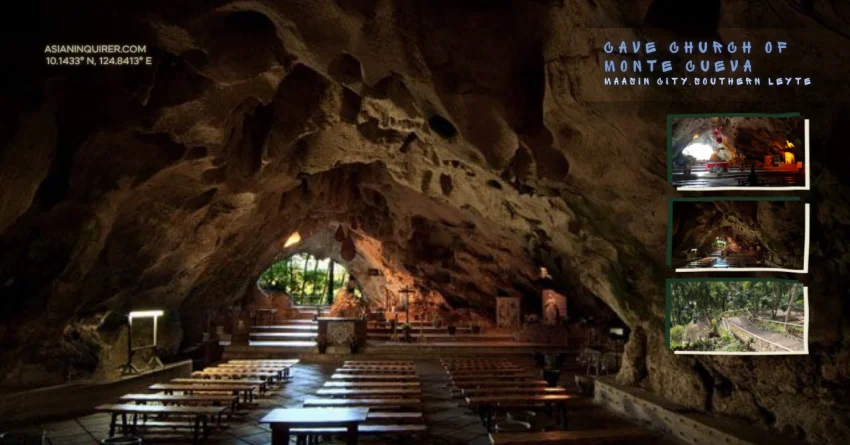
Reaching the summit is a sensory shift I won’t soon forget. You don’t walk into a building; you walk into the earth. The mouth of the cave opens wide, welcoming you into a natural cathedral that makes traditional architecture seem almost fragile by comparison.
Inside, the temperature drops instantly. Even on a sweltering Philippine afternoon, the interior of Monte Cueva remains naturally chilled and damp. I felt the sweat on my brow turn cold as I looked up at the ceiling, a magnificent, raw masterpiece of stalactites that have been forming for centuries.
The altar is tucked at the far end of the cavern. It is simple, dignified, and bathed in a soft, artificial glow that competes with the natural light filtering through the cave’s mouth. Because of the cave’s natural acoustics, even the softest whisper carries. I sat on one of the wooden pews, listening to the gentle drip of water hitting the stone floor. It felt as if the mountain itself was breathing with me.
A View from the Edge of the World
After spending time in the quiet gloom of the cave, stepping out onto the viewing deck is like a sudden burst of color.
From this vantage point, the entirety of Southern Leyte seems to unfold at your feet. I stood there, looking out over the sprawling green canopy toward the urban center of Maasin. Beyond the city, the Canigao Channel shimmered like a sheet of blue glass under the sun. It is one of those rare places where you can see the hustle of human life from a distance great enough to realize how small it all is.
I saw a few photographers trying to capture the scale of the horizon, but most people were doing what I was: just standing in silence, letting the wind from the sea wash over them.
Practical Tips for Your Pilgrimage
If you’re planning to visit this “Shrine in the Sky,” let me share some first-hand advice to make your trip smoother:
- Footwear is Key: Don’t wear flip-flops. The steps are concrete, but they can get incredibly slippery after a light Leyte rain. I wore trekking sandals with a good grip, and I was glad I did.
- Modesty Matters: Remember that this is a sacred site. While it’s a popular travel spot, it is first and foremost a place of worship. I recommend wearing modest clothing out of respect for the devotees and the shrine.
- Hydration: There are usually small stalls at the bottom, but I highly suggest bringing your own water for the climb. You’ll need it halfway up.
- Observe the Silence: Monte Cueva is a designated “Zone of Peace.” Keep your voices low. The beauty of the cave is found in its stillness.
Why Monte Cueva Stays With You
As I made my way back down those 500 steps, my legs felt heavy, but my spirit felt incredibly light.
Monte Cueva is a testament to the Filipino spirit’s ability to find the divine in the natural world. It reminds us that we don’t always need gold-leafed altars or stained glass to connect with something larger than ourselves; sometimes, all we need is a hole in a rock and a long, hard climb to change our perspective.
Whether you are a devout pilgrim or a traveler seeking a moment of respite from the modern pace of life, Monte Cueva offers a rare opportunity to find peace in the literal heart of the earth. It isn’t just a highlight of a Southern Leyte itinerary. It’s a reset button for the soul.
Have you ever discovered a place that felt like a sanctuary in the stone? Tell me about your favorite hidden gems in the comments below!