
Most people think the Philippines ends at the tip of Jolo in the Sulu archipelago.
This province is actually the true punctuation mark of our southern map where the air feels ancient and the ocean looks like liquid glass. It is a place where your wallet stays in your pocket while your hands do the talking in the middle of a busy market.
In the municipality of Panglima Sugala, a weekly market called Tabo-Tabo brings the highlands to the coast every Friday afternoon.
People from the mountain villages bring heavy sacks of root crops like pangi to the seaside to meet with the maritime communities. They do not use pesos or coins to get their dinner from the fishermen who have spent all night on the Celebes Sea. It is a fascinating technical troubleshoot for a community that values resources over paper money.
You see bright orange sea urchins dug straight from the sand and giant clams piled high on wooden tables under the tropical sun. The negotiation is a quiet and respectful dance of smiles and nods that ends with a firm handshake between the two traders.
It is a living tradition that makes modern global currency feel entirely unnecessary for the survival of the tribe.
Crossing the Longest Mainland Road
Leaving the market behind, the road opens up into a motorcyclist’s dream that few people in the northern provinces will ever see. You cross a massive bridge that connects the island of Bongao to the rest of the mainland.
On one side you see dense and emerald mangroves and on the other the infinite and shimmering blue of the Celebes Sea.
The tarmac ahead is a perfectly straight line that cuts through a thick canopy of deep green trees. There is almost no traffic here to disturb the peace of the landscape as you twist the throttle toward the distant coast.
You might notice locals selling golden liquid in glass liter bottles along the highway near the small barangays. This is fuel imported directly from nearby Sabah, Malaysia, because the international border is closer than the nearest major city. It smells like the border and costs about one hundred and sixty pesos per liter at these specific coordinates.
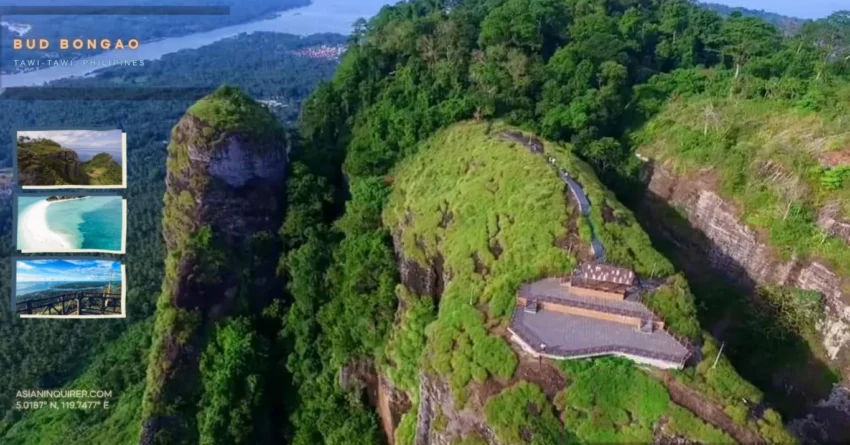
Bud Bongao watches over you from the distance like a silent and sacred stone guardian of the island.
A Taste of the Tausug and Sama Flavor
Hunger will eventually lead you to the rich and dark flavors of the local Tausug and Sama gastronomy.
You must try the Tiyula Itom which is a beef stew with a broth as black as coal. This unique color comes from heavily charred coconut meat mixed with local ginger, turmeric, and secret spices.
Another marvel is Oco-Oco where a sea urchin shell is stuffed with spiced rice and boiled until the flavors meld.
You crack the shell open like a hard-boiled egg to find a savory treat infused with the brine of the sea. It is a flavor that anchors you to the maritime identity of the Sulu Archipelago.
Every bite tells a story of survival and celebration in the deep south.
The Longest White Sandbar in the Philippines
A wooden boat will take you further south toward a blinding white line on the horizon.
Panampangan Island holds the official record for the longest sandbar in the entire country.
At low tide, the sand stretches for over three kilometers through the turquoise water in a perfect curve. You feel like you are walking on a velvet path through the middle of the sea with water lapping at your bare feet. It is a rare experience where the horizon seems to be moving away from you as you walk along the white powder.
Make sure you carry every piece of trash back to the mainland to keep the sand as white as snow.
Simunul Island and the Islamic Foundation
The final coordinate of your journey is a small island that holds the spiritual foundation of the entire region. Simunul Island is a place where the history of faith began for the archipelago.
Established in 1380, this is the home of the Sheikh Karimol Makhdum Mosque. It was built long before the arrival of the Spanish in the northern islands and stands as the oldest mosque in Southeast Asia.
Inside the modern walls, the four original wooden pillars still stand as a bridge to the ancient past.
You are required to wear modest clothing and leave your shoes at the door out of respect for the sacred ground. It is a sanctuary that welcomes travelers of all backgrounds with open arms and a quiet grace. This mosque marks the historic birthplace of Islam in our islands more than a century before Magellan arrived.
The edge of the map is not a place of ending but a place of beginning.
Practical Travel Tips for the Tawi-Tawi Explorer
Planning a trip to Tawi-Tawi requires a bit of research to ensure your journey is safe and culturally respectful.
You should book a flight to Sanga-Sanga Airport in Bongao which is the primary gateway to the province. Most travelers choose to hire a local tricycle or rent a motorcycle for around five hundred pesos to explore the mainland towns.
The best time to visit is during the dry season from March to June for the calmest sea crossings.
You must bring enough cash because ATMs are only available in Bongao and they often run out of bills during the weekend.
It is wise to coordinate with the local tourism office to secure a registered guide for your island hopping trips. They will help you navigate the schedules for the barter trade and the boat rides to Simunul Island.
Always wear sun protection and bring plenty of drinking water because the heat on the open sandbar is intense.
Respect the local customs by asking for permission before taking photos of people or private religious structures.
The peace you find here is a result of the community’s deep connection to their heritage and their land.
Notable landmarks include the sacred Bud Bongao where you can hike to the summit to see the entire archipelago. You should also visit the MH Cafe to try their authentic Tiyula Itom after your mountain trek. If you are there in September, make sure to catch the Agal-Agal Festival which celebrates the seaweed industry.
This event is a sensory explosion of color, dance, and traditional music that you will never forget.
Tawi-Tawi is a safe and welcoming destination for those who travel with an open heart and a curious mind.
Reflecting on the Real Edge
We often travel to find new sights but we end up finding parts of our own history that we never knew existed.
The long sandbar and the ancient pillars of Simunul are just frames for a much larger picture of human resilience. Every kilometer I traveled felt like a lesson in how beauty can thrive in the most remote corners.
The world is much wider than the taglines we hear in the city.
Tawi-Tawi teaches us that the coordinates of our home extend far beyond our comfort zones. I hope your next journey leads you to the real edge of the world.
Maybe we should all stop rushing toward the center and start looking at the beauty that lives on the borders.
The road is open and the white sands are waiting for your story.