
Just a few kilometers south of the bustling capital of Dumaguete lies a small town where time seems to slow down.
Officially established in 1801, Bacong holds the title of the oldest town in Negros Oriental. It is a place where the air smells of the Mindanao Sea and the streets are shaded by giants.
Whether you are a history buff, a spiritual seeker, or a fan of local craftsmanship, Bacong offers a serene blend of stone-walled heritage and modern coastal charm.
History & Landmarks
Exploring Bacong is akin to walking through a living museum. The town’s very name is rooted in resilience.
It’s derived from the word “bacon,” a local call to “rise up and fight,” reflecting a community that stood firm against historical sea raids.
Major Landmarks
1. San Agustin de Hippo Parish Church
The “crown jewel” of the town is undoubtedly this National Cultural Treasure. Built in 1865, it is the best-preserved church complex in the province.
- Unique Composition: While most regional churches utilize coral stone, San Agustin stands out for its masterful brick architecture.
- The Tallest Belfry: Its bell tower is the highest in Negros Oriental, originally serving as a vital watchtower to spot incoming pirates.
- A Musical Relic: Inside, you’ll find a rare, functioning pipe organ brought from Zaragoza, Spain, in 1894—its hauntingly beautiful tones still echo through the nave today.
2. The Legend of Leon Kilat
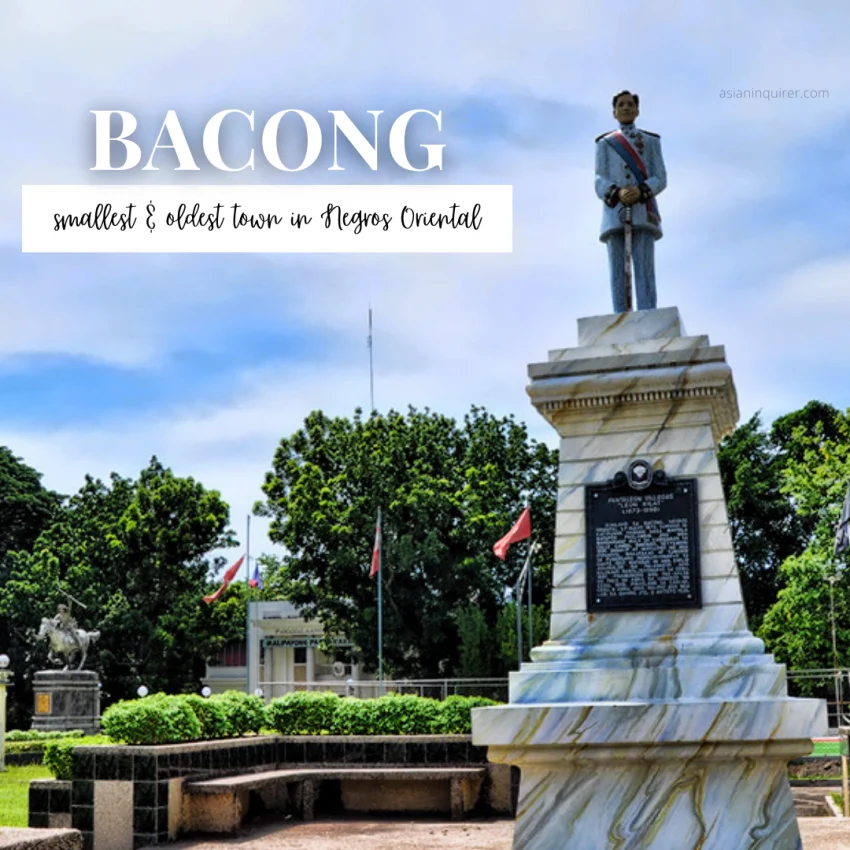
Bacong is the proud birthplace of Pantaleon Villegas, better known as the revolutionary hero Leon Kilat. At the heart of the sprawling Municipal Plaza, a majestic equestrian statue of the hero stands guard.
The plaza itself is a sight to behold, draped in the lush, green canopy of century-old Acacia trees, making it arguably one of the most beautiful public squares in the Philippines.
A Hub of Craftsmanship and Culture
Bacong isn’t just about looking backward, it is a thriving center for the arts and local tradition.
- Negros Oriental Arts and Heritage (NOAH): This world-renowned factory is a must-visit for those who appreciate fine detail. Here, artisans practice the meticulous “stone-on-stone” mosaic technique, transforming raw stones into lacquerware and jewelry exported across the globe.
- Sinulog de San Miguel: If your timing is right, you might witness the Sinulog de San Miguel in the San Miguel district. This isn’t just a dance, it’s a vivid dance-drama depicting the eternal struggle between Saint Michael the Archangel and the forces of evil.
Bacong in 2026 (Modernity Meets Tradition)
As of 2026, the town has successfully bridged the gap between its storied past and a growing future. The Leon Kilat Mall has emerged as the new center of commercial activity.
Located strategically at the town center, the Leon Kilat Mall offers air-conditioned dining and shopping that once required a trip to Dumaguete, all while keeping visitors within arm’s reach of the town’s historical landmarks.
Expected to rise soon is the new Bacong Airport Project also tagged as The New Dumaguete Airport, located in Isugan, Bacong, Negros Oriental. It is a major international gateway project designed to replace the existing, congested Dumaguete-Sibulan Airport.
Built to meet modern international standards, the facility will feature a state-of-the-art runway and taxiway, dedicated passenger and cargo terminals, and a new control tower to accommodate the province’s growing air traffic.
Other Town Features and Highlights
Best For: Heritage tours, stone-craft shopping, and quiet seaside walks.
Key Vibe: Deeply spiritual, resilient, and historically grounded.
Landscape: Black sand shorelines and ancient coral-stone structures.
Take a moment to sit under the Acacias in the plaza during the golden hour. The way the light filters through the ancient branches captures the true essence of Bacong.
It’s an unbreakable link between the roots of the past and the light of the present.